Alexander Voet
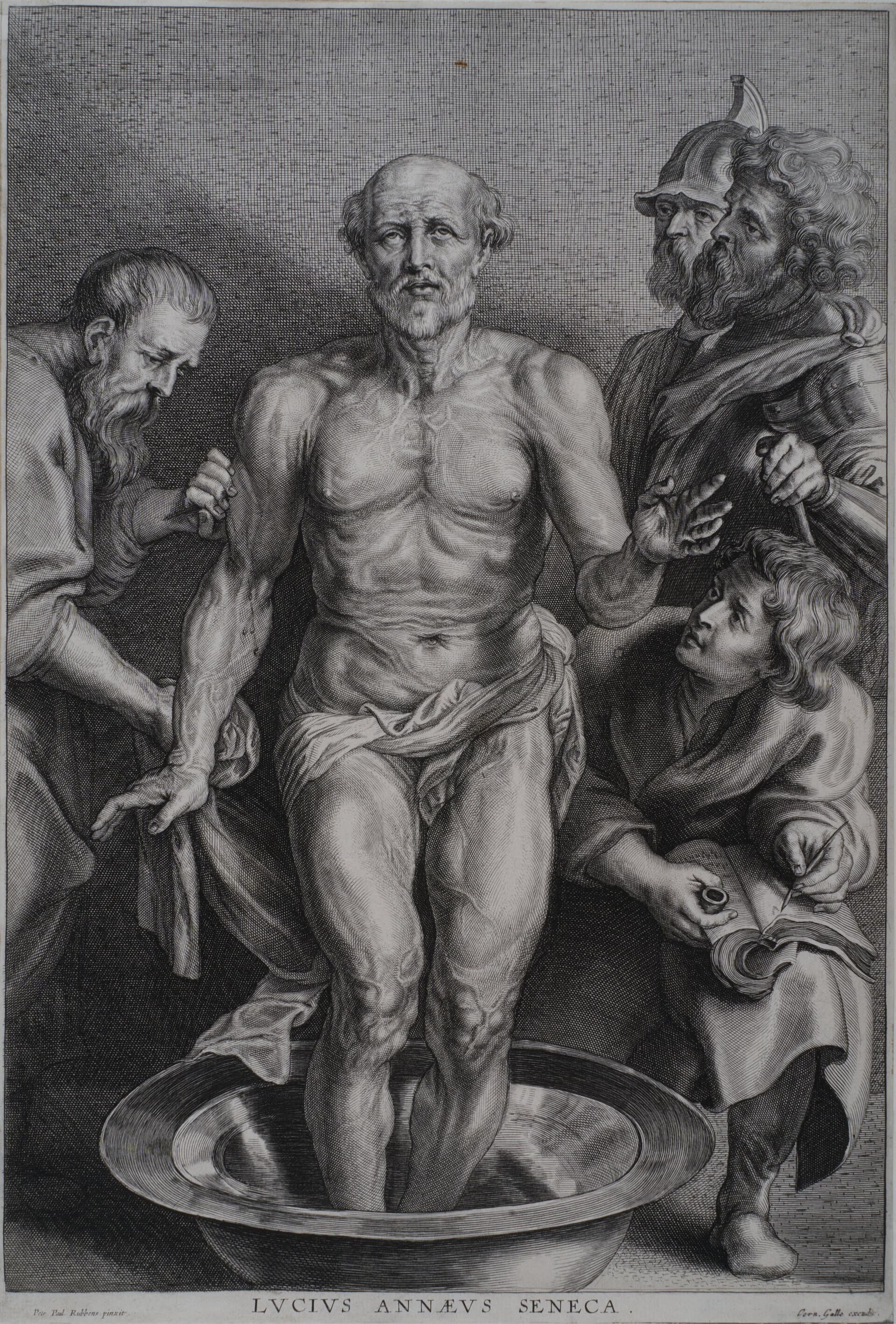
The Death of Seneca
Creation
c. 1655 - 1678
Dimensions
40.5 x 27.5 cm
Material / Technique
paper/engraving
Rubens prints
prints, photographs
Engraver
Alexander Voet (1628 - 1689)
Artist
Peter Paul Rubens (1577 - 1640)
Publisher
Cornelius Galle (1615 - 1678)
About the object
Seneca was a Roman politician, philosopher, and, as an exponent of Stoicism, one of the most widely read authors of his time. His life ended in an act of suicide ordered by Emperor Nero, his former student. This was occasioned by the Pisonian conspiracy directed against the ‘despotic’ regime of Nero. It is unclear whether Seneca was actually involved in the plot.
Seneca is said to have faced death in accordance with Stoic principles: with equanimity and calm submission to his fate. Rubens’s composition vividly captures that mood.