Jean-Marc Nattier
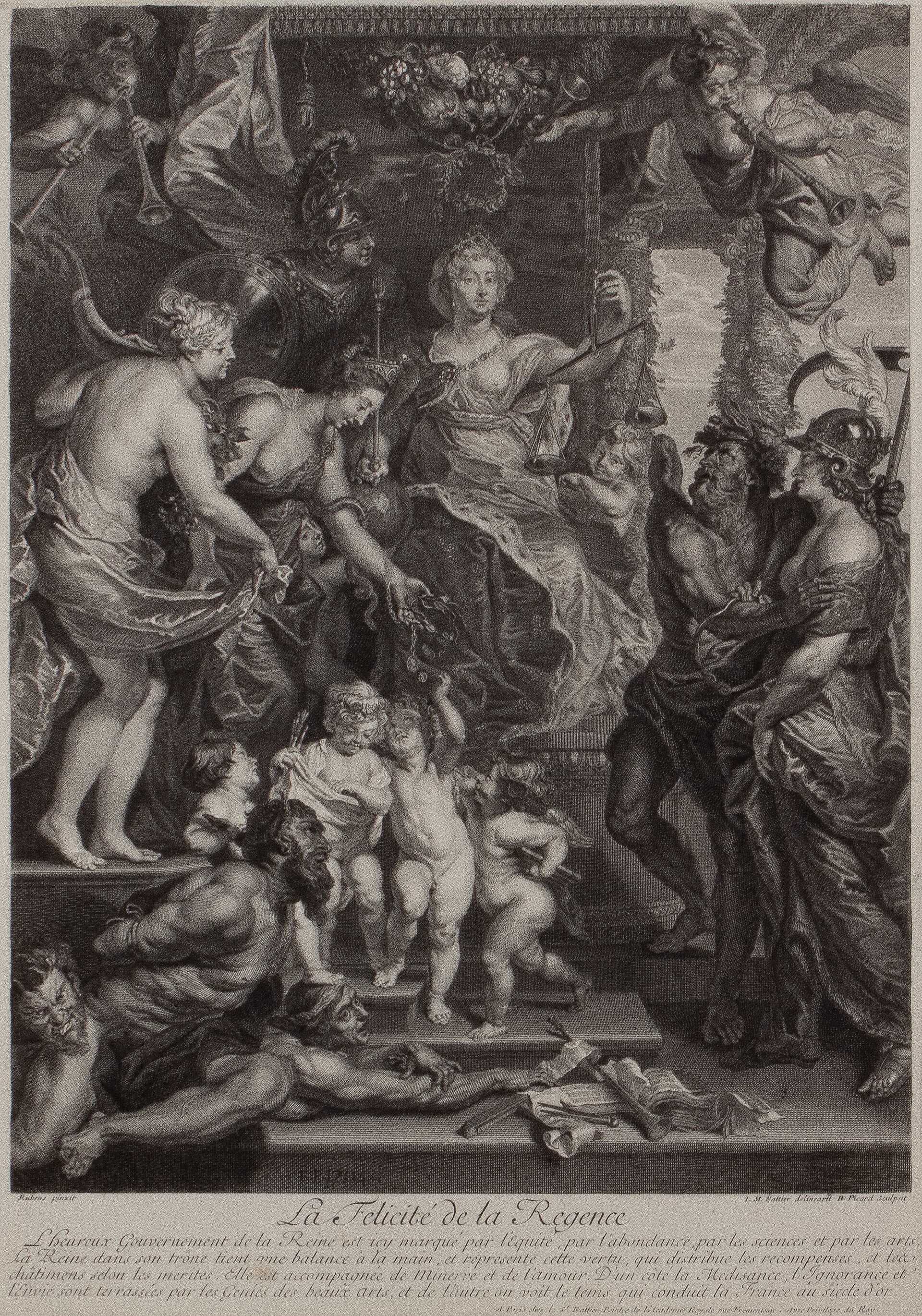
The Felicity of the Regency of Maria de’ Medici
Creation
1673 - 1733
Dimensions
44.8 x 34.3 cm
Material / Technique
paper/engraving
Rubens prints
prints, photographs
Artist
Jean-Marc Nattier (1685 - 1766)
Artist
Peter Paul Rubens (1577 - 1640)
Engraver
Bernard Picart (1673 - 1733)
About the object
In 1622, Rubens was commissioned by Maria de’ Medici to depict her life and achievements in a cycle of paintings. He faced a difficult task: to portray positively the controversial political role of the French queen, who, after the death of her husband, ruled as regent while Louis XIII was still a minor.
Rubens seized the opportunity to demonstrate contemporary concepts of virtuous rulership through the person of Maria de’ Medici:
The pair of scales held up by the queen represents justice. Personifications of generosity and abundance present her with flowers, fruits, and jewellery. Musical instruments, paintbrushes, and books represent the sciences and fine arts. Maria herself embodies an ideal of peace and the hope for a golden age.