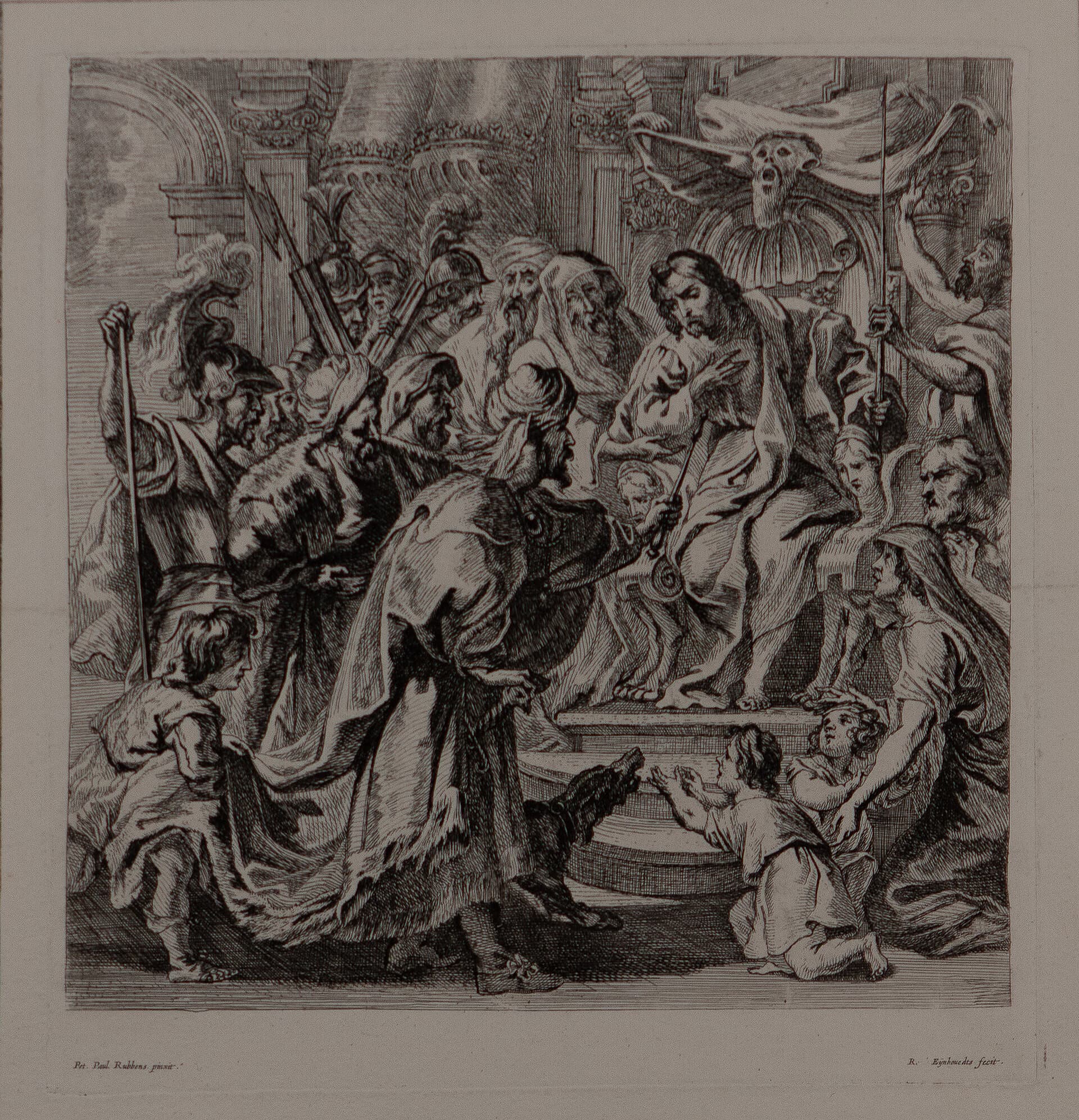
Remoldus Eynhouedts
The Judgement of Cambyses
Dimensions
29.8 x 28.1 cm
Material / Technique
paper/etching
Rubens prints
prints, photographs
Engraver
Remoldus Eynhouedts (1613 - 1679)
Artist
Peter Paul Rubens (1577 - 1640)
About the object
The Persian monarch Cambyses II (529 – 522 BC) ordered the judge Sisamnes to be executed by flaying as punishment for bribery. Cambyses then had the chair of judgement draped with Sisamnes’ skin, appointed the dead judge’s son as successor, and forced him to sit in the chair. Rubens depicts Cambyses in ‘oriental’ dress, including a turban. The monarch points his sceptre at the son of Sisamnes in a gesture of warning.
The story was recorded by the ancient historian Herodotus. It is emblematic of an extreme notion of justice meted out by a ruler, all the more so from today’s perspective.